EVAN
STACHOWIAK
I build AI systems with a ground-truth understanding of how real operations work
SYRACUSE IMT '27 / DATA SCIENCE INTERN / AI ENGINEERING
About
I look at systems from angles others tend to overlook, both the big picture and the small details that hold it all together. That instinct led me to quality assurance, where I earned an ISO 9001:2015 Internal Auditor certification and spent two internships analyzing workflows, standardizing documentation, and finding inefficiencies before they became problems.
At E.C. Styberg Engineering, that work has become data work spanning quality systems, inventory, and commercial process. Different problems, same move: find where the record and reality have drifted apart, close the gap, and build something that keeps it closed. Sometimes that's a compliance gap everyone assumed was covered, sometimes it's inventory that doesn't match the floor, sometimes it's a process documented one way and run another. It's also made me the person in the room when outside technology meets the shop, pressure-testing vendor claims against how the plant actually runs.
I build the same way on my own time. An analytics platform that stores every model prediction next to the edge it claimed, so calibration is measurable after the fact. An autonomous research agent with no framework hiding the loop and a budget gate that halts execution when it should. A wardrobe app whose color engine is isolated from the UI by a CI check that fails the build if a framework dependency leaks in.
The through line is caring whether something actually works and being able to prove it. Senior in Information Management and Technology at the Syracuse University iSchool, concentrating in information security. Looking for full time data, AI, or process engineering roles starting summer 2027.
How I got here
I'm Evan Stachowiak, and I build things. I grew up between two worlds: a mother with a doctorate in nursing education and a father who ran manufacturing companies. One side gave me a deep respect for understanding how things actually work; the other gave me an early, hands-on feel for how a business runs on the floor. My childhood was split between the suburbs and a horse rescue in Wisconsin, which mostly meant manual labor and weekends building and fixing things next to my dad.
One of those projects was a horse shelter. We built it by measuring the old one, working out every material and how the pieces fit, and turned it into a plan we could actually execute. That loop - understanding the inputs, how it works, then building it, has never left me. A few years later, at 13, I watched my dad run gutters in a way that made no sense to me, suggested a cleaner method, and it worked. That was when I realized I had a knack for seeing how things should work, as long as I understood why they work first.
That curiosity runs through everything, not just code. I started college on a vocal performance scholarship, which is where I learned to drill a hard skill until it becomes automatic, before the build instinct won and I moved into tech. I learn the same way regardless of the subject: break it down to fundamentals, build a working understanding from the bottom up, then get hands on and learn the rest by making mistakes fast. It is how I taught myself to ski and snowboard in a day each and ended up instructing.
My edge is where that curiosity meets discipline. I came up through quality and operations work in manufacturing, which made me genuinely analytical and critical about how things get built. Pair that with a real passion for statistics, the kind that has me thinking in expected value at the poker table as readily as in my work, and my information-management coursework, and you get what I actually do well: build with AI and keep it reliable. As a data science intern I put that to work right away, catching several errors in a costing model in my first week and automating documentation that would have cost a small team a week of manual effort.
“The question is never whether I can build it. It is what to build next.”
Everything else I have built came from the same place: sports analytics tools and an autonomous AI agent that researches and writes my morning briefing. Find the leverage point, learn what I need, and sweat the details until it feels right. I care how things look and not just whether they work, and the same discipline that keeps me consistent in the gym is what keeps me refining a build long after it runs. At this point the question is never whether I can build something. It is what to build next.
Projects
Demo media in production
Screenshots and a video walkthrough of the live app are being produced.
StyleStack
A wardrobe app built on a single premise: if you extract a garment's actual color properly, outfit compatibility becomes a solvable problem rather than a matter of taste.
The center of the project is a pure TypeScript engine, deliberately isolated from the UI. It takes an item plus the outfit in progress and returns a verdict with reasons, and every grey-out and badge in the interface is that one function's output. CI enforces the isolation rather than trusting convention: if a framework dependency leaks into the engine, the build fails.
Quant Edge Tracker
A sports analytics platform powered by a headless agent SDK and background strategy daemons.
A personal analytics platform for tracking position performance across sports markets. I built it to answer one question: is there a measurable edge here, or is it just variance? Every position stores the model's claimed edge at the time it was taken, so calibration is measurable after the fact. Across 59 predictions on one strategy it projected 53.0% and realized 39.6%, a 13.4 point overconfidence gap.
AI News Agent
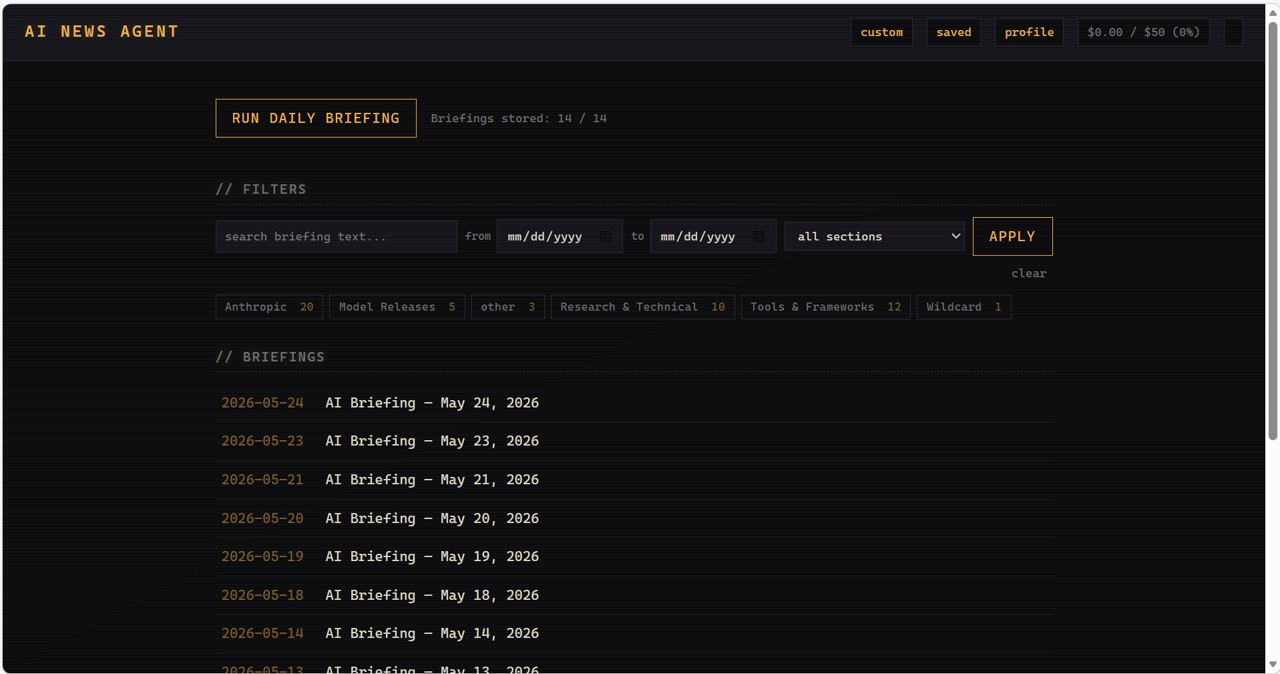
An autonomous agent that researches the day and writes my morning briefing before I am awake to read it.
AI News Agent is a self-running daily briefing. A hand-rolled agent loop gathers and ranks the day's news against a profile of what I care about, drafts a tight summary, and emails it on a schedule. It keeps persistent topic memory so the briefing sharpens over time, includes per-item Q&A and budget tracking, and was later rebuilt on Claude Code Routines and the Resend MCP.
>_Resume
Relevant Experience
Data Science Intern
E.C. Styberg Engineering & Manufacturing
May 2026 to Present
- Built a new business tracker that consolidated opportunity data previously scattered across spreadsheets and inboxes, so pipeline status is visible in one place rather than reconstructed on request
- Rebuilt tooling room inventory records, reconciling system data against what was physically on the floor and establishing a process to keep the two aligned
- Reviewed internal estimating processes, documenting how they work in practice against how they were designed to work
- Acted as technical liaison for a third-party AI tool evaluation, translating between the vendor and internal stakeholders and pressure-testing vendor claims against how the shop actually operates
- Extracted control plan and PFMEA data from a legacy quality planning tool into auditable form, standardized operation descriptions across the corpus, and mapped process characteristics to failure modes to surface IATF compliance gaps
Quality Assurance Intern
E.C. Styberg Engineering & Manufacturing
May 2025 to Aug 2025
- Reformatted instructions and policies into a standardized company-wide format, and built a Python application to parse legacy documents into the new template (bulkDocReformat)
- Ensured all documents were properly controlled under the quality system
- Earned ISO 9001 Internal Auditor certification
Undergraduate Teaching Assistant, IST 263
Syracuse University iSchool (Intro to HTML & Front-End Web Design)
Jan 2025 to May 2025
- Selected as an undergraduate TA; supported 20+ students in HTML/CSS debugging through one-on-one guidance and example-based instruction
- Created supplemental materials translating complex front-end concepts into accessible, step-by-step demonstrations
Quality Assurance Intern
Stainless Foundry & Engineering, LLC
May 2023 to Aug 2023
- Managed and standardized outdated melt procedures, converting physical documents into organized digital records
- Created new documentation for each melt material, including reference images, to prevent misidentification
- Improved department accessibility for floor workers who did not speak English by restructuring the filing system
- Recognized with the SFSA Schumo Scholarship for this work and presented it at a national industry conference
Projects
StyleStack(In Progress)
Next.js App Router, TypeScript, Supabase RLS, pnpm monorepo, Vitest, fast-check
- Built a wardrobe app around a pure TypeScript compatibility engine, isolated from the UI, held at 100% branch coverage, and tested with property-based generation
- CI enforces the engine isolation: ESLint bans framework imports, the package builds standalone, and the build fails if a dependency leaks in; 82 test files across the workspace
Quant Edge Tracker(Shipped)
React 19, TypeScript, Vite, Tailwind v4, shadcn/ui, Supabase, Recharts, Vercel
- Built a sports analytics platform: a data pipeline plus modeling layer that converts market lines into fair, vig-adjusted probabilities
- Stores every prediction next to the edge it claimed: across 59 predictions one strategy projected 53.0% and realized 39.6%, a 13.4 point overconfidence gap the measurement layer exists to catch
AI News Agent(Shipped)
FastAPI, Claude API, Resend, Fly.io, Claude Code Routines, Resend MCP
- Shipped an autonomous daily briefing: a hand-rolled agent loop of roughly 150 lines that researches, ranks, and writes a personalized news summary on a schedule
- Added persistent topic memory, per-item Q&A, and enforced budget caps; 373 tests with every Anthropic call mocked; later rebuilt on Claude Code Routines and the Resend MCP
Volunteering
Volunteer Caretaker
Local animal rescues
2013 to 2025
- Grew up living on a horse rescue and volunteered across multiple animal rescue organizations for over a decade
- Daily feeding, grooming, exercising, and stall maintenance for rescued horses; pen cleaning, walking, and behavioral training assistance for rescue dogs
Education
Syracuse University
School of Information Studies (iSchool)
Bachelor of Science, Information Management & Technology
Concentration in Information Security
Expected May 2027 (Senior)
Relevant Coursework
Skills
Programming
Tools & Platforms
Data & Analytics
Quality & Compliance
AI & Emerging Tech
Certifications & Awards
- ISO 9001:2015 Certified Internal Auditor
- Microsoft Excel Certified
- SFSA Schumo Scholarship Recipient
- VPA Leadership Scholarship
- SFSA National Conference Presenter